
November 24, 2025

The Last Testament
Logline:
In a purgatorial afterlife, a fallen man gets a second chance to redeem his life’s sins and confront his guilt in a crime-ridden noir world, guided by his conscience, the angel side, and manipulated by the Luciferian shadow side.
Pitch:
The film begins by the protagonist waking up under water, tied up, but gets miraculously released and surfaces into a dark underworld version of reality.
The film explores religious themes and conversations amidst stylistic action sequences.
There are two twists in the end: First, the assumed angelic side turns out to be the devil side, who has been playing a good guy all along, manipulating the protagonist to shoot and destroy the corrupted and fallen but true conscience in order to gain full control of the protagonist. Second, after achieving to destroy the true angel of darkness in a fiery battle, the protagonist wakes up from a coma, his face burned, somewhat absolved, hoping to meet his angel side at some point again.
© Nikolas Keskilammi 2025
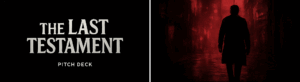
THE LAST TESTAMENT — Pitch Deck
1. Logline
In a purgatorial afterlife, a condemned man awakens in a noir underworld where he is offered a second chance at spiritual redemption—guided by what he believes are angelic and demonic forces. But in a world built from his sins, nothing is what it seems.
2. Core Premise
The Last Testament is a metaphysical action–noir about the battle for a man’s soul.
Set in a surreal purgatory—a dreamlike city of shadows, neon reflections, and moral ambiguity—the protagonist must confront his darkest memories, old crimes, and buried guilt.
This world is not heaven or hell.
It is himself—a psychological battlefield where conscience, temptation, truth, and deception take shape as characters.
3. The World: Purgatorial Noir
A hybrid of:
Blade Runner
Constantine
Se7en
Sin City
Jacob’s Ladder
A place where:
Streets echo past sins
Buildings shift to reflect inner turmoil
Characters appear and vanish like thoughts
Violence is symbolic
Dialogue is philosophical
Light and shadow fight for dominance
The world is the protagonist’s mind, memory, and morality externalized.
4. Opening Sequence
A man wakes underwater, bound, sinking.
He struggles.
He fails.
He accepts death.
And then—the ropes dissolve like smoke underwater.
He erupts to the surface, gasping, emerging into an empty, neon-lit waterfront of a dark, corrupted mirror of reality.
This miracle is the first sign that:
He is dead
He is reborn
He is being judged
And he is not alone
5. Characters
The Protagonist: The Condemned
A former criminal stricken by guilt and regret.
Not a hero.
But not fully lost.
This is his final chance to face the sins he ran from in life.
“The Angel” — The Deceiver
Appears kind, righteous, and protective.
Speaks in parables.
Guides the protagonist through missions to “purify” the city.
But in truth:
He is Lucifer in disguise, manipulating the protagonist into destroying his conscience.
“The Shadow” — True Conscience
Cryptic, unsettling, morally ambiguous.
Seems dangerous at first.
Refuses to comfort the protagonist.
Challenges him.
Tells him truths he doesn’t want to hear.
The audience—and the protagonist—believe he is the devil.
But he is actually:
The protagonist’s last remnant of truth.
6. Themes
Redemption & Responsibility
You cannot outrun your sins.
You must face them.
Spiritual Warfare
The greatest deception hides in light, not darkness.
The false angel.
The false righteousness.
The seductive lie of “easy absolution.”
Identity & Memory
Your past forms the architecture of your soul.
Your guilt shapes your demons.
Your conscience—if ignored—becomes a stranger.
Good vs Evil Is Not What It Seems
Light can be a trap.
Darkness can be truth.
Morality requires struggle, not comfort.
7. Structure
Act 1 — Awakening & Guidance
The protagonist emerges from the water.
The “angel” saves him and gives him purpose.
The “devil” stalks him, confronts him.
Missions begin to “cleanse” the underworld.
Act 2 — Rising Action & Philosophical Conflict
Noir investigations into his past sins.
Surreal action sequences revealing who he used to be.
Emotional confrontations with memories.
The angel pressures him to destroy the devil.
Doubts grow.
Act 3 — Revelation & Betrayal
Twist #1:
The angel is Lucifer.
The devil is his conscience.
The devil tricks the protagonist to shoot and kill his conscience.
A fiery final battle erupts between the protagonist and the false angel.
Act 4 — Resurrection
Twist #2:
After the false angel is destroyed and the protagonist victorious…
…the protagonist wakes from a coma, face burned, body wrecked, spiritually shaken.
He breathes.
Alive.
Barely.
He runs away into hiding, hoping that somewhere—
his true conscience still survives.
8. Visual Style
Neon noir
Water symbolism (baptism, drowning, rebirth)
Fire symbolism (judgment, destruction, rebirth)
Heavy shadows
High contrast
Slow-motion metaphysical action
Symbolic use of guns and violence
Dreamlike transitions
Mirrored sets
Biblical visual motifs (wings, serpents, thrones, candles, lanterns)
9. Inspirations
The Crow
The Fountain
The Machinist
Oldboy
Drive
Angel Heart
Philosophical + psychological + spiritual cinema.
10. Why This Film Matters
The Last Testament is a rare blend of:
Action
Psychological depth
Philosophical richness
Spiritual revelation
Noir aesthetic
High-concept storytelling
Small-to-medium budget accessibility
A film that audiences will watch twice:
Once for the spectacle
Once for the meaning
It elevates action cinema into spiritual art.
11. Market Appeal
For fans of:
Elevated thrillers
Religious symbolism
Mind-bending narratives
Redemption arcs
Dark spiritual cinema
“Small budget but epic-feeling” films
Production Advantages
Limited characters
Stylized sets
Surreal effects
Ideal for streaming audiences
Strong international appeal
12. Closing: The Heart of the Story
The Last Testament asks:
If you were given one final chance to correct the story of your life…
would you recognize the voice of truth when you heard it?
A spiritual action noir for the modern age.
© Nikolas Keskilammi 2025
Leave a Comment
You must be logged in to post a comment.