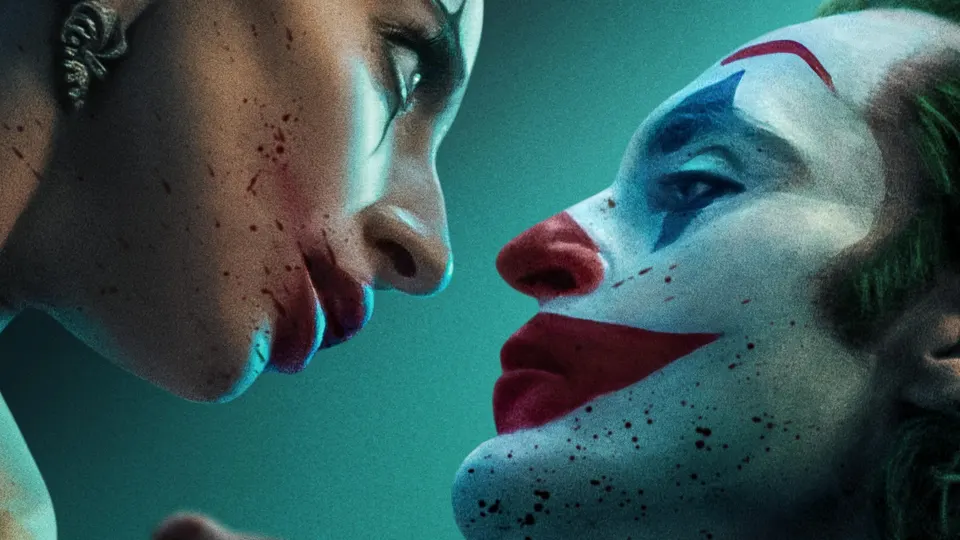
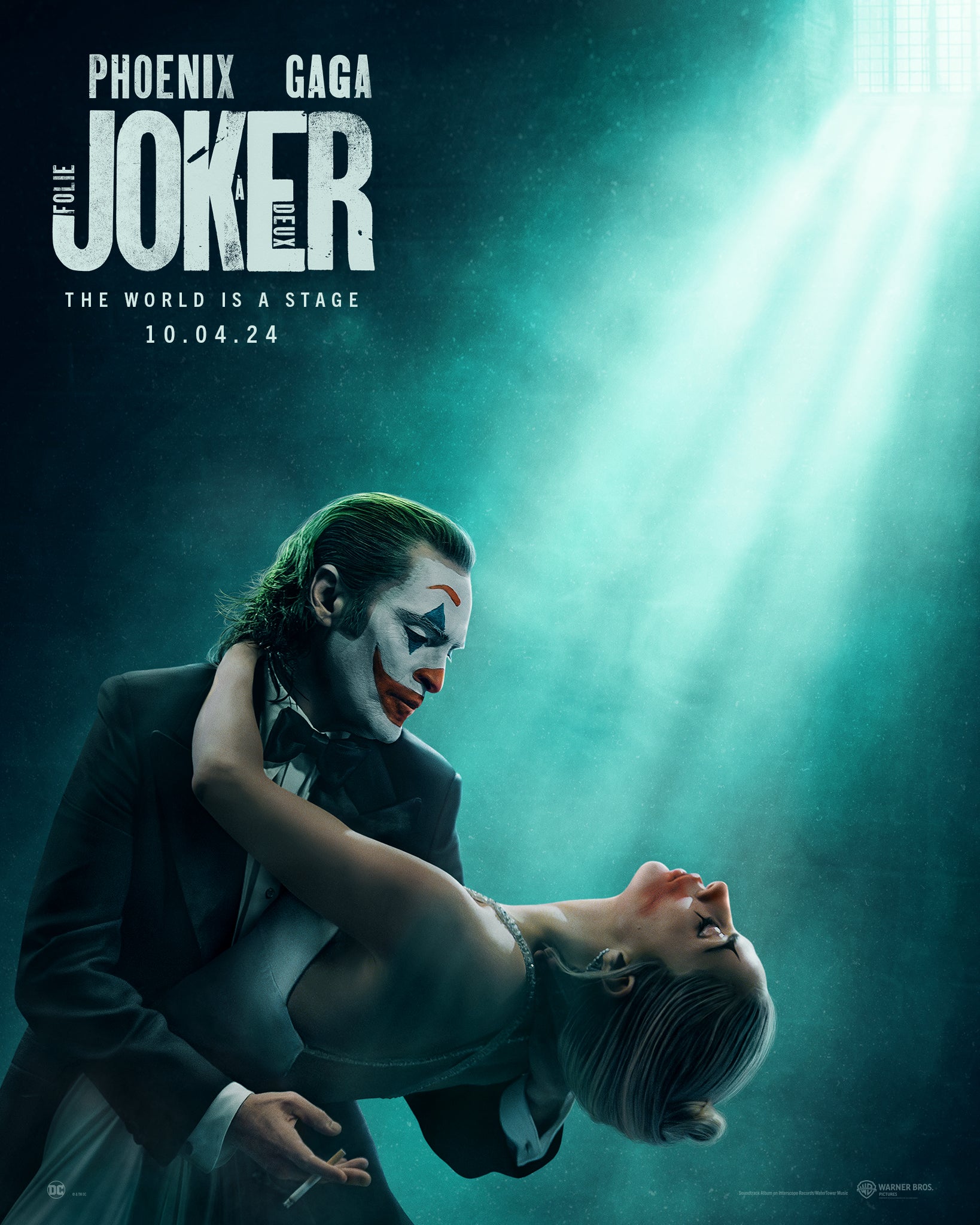
When Joker: Folie à Deux hit theaters in 2024, most people didn’t know what to make of it. Was it a sequel? A musical? A romance? A joke? Critics called it strange, indulgent, even unnecessary. Fans of the first Joker were baffled by the shift from gritty realism to surreal song-and-dance.
However, many audiences, such as myself, were captivated by its audacious musical numbers, the twisted romance of Arthur Fleck and Harley Quinn, and the visual spectacle of Gotham’s descent into chaos. Yet, beneath the surface of song and dance, the film carries a far deeper, almost mythic resonance: a prophetic allegory about the fractured nature of human connection, the dangers of shared delusion, and the consequences of society’s failure to unify the masculine and feminine.
Viewed through the lens of archetype and prophecy, Folie à Deux is not merely a story about a man and a woman falling into madness together — it is a dark mirror of society itself, a cautionary tale about what happens when love, identity, and culture are built on illusion.
Todd Phillips and Joaquin Phoenix didn’t just make a sequel; they created a warning. Now, only a year later, it has become clear that Folie à Deux was not just a sequel, not just a performance piece, but a prophetic mirror of our cultural moment. Its meaning, once obscure, now shines with almost frightening clarity.
Misunderstood on Release
In 2019, Joker gave us Arthur Fleck, a lonely man transformed into a symbol of chaos. In 2024, Folie à Deux gave us Arthur in search of love — and finding it in Harley Quinn (Lady Gaga). At the time, most viewers and critics saw the film through two limited lenses:
- As a sequel to a comic-book film: Many expected another gritty “origin story” in the vein of Joker (2019). Instead, they were met with a stylized, semi-musical exploration of madness, love, and shared delusion. The tonal shift felt dissonant, and audiences recoiled.
- As a psychological romance gone wrong: Critics framed it as a dysfunctional love story between Arthur and Harley, bound together by madness. While this reading is not wrong, it misses the prophetic scope of the film’s imagery, its commentary on society, and its spiritual allegory.
History is filled with works of art dismissed in their time only to be recognized later as prophetic — from Van Gogh’s paintings to Ridley Scott’s Blade Runner. Joker: Folie à Deux belongs to this lineage.
Initial reviews framed the film as either a failed musical experiment that paled beside its 2019 predecessor. However, such readings reveal more about audience expectation than about the “text” itself. In retrospect, Folie à Deux is not an anomaly but a vision — one that was simply released too early for cultural comprehension.
At the time, the musical numbers seemed absurd. Why would a story about madness burst into song? Today, the answer feels obvious: because that’s exactly what we’ve been doing. Singing, dancing, and distracting ourselves as the world falls apart.
What they missed was the larger allegory: this was never just about Arthur and Harley. It was about us.
Here’s the thing: we weren’t ready. The film arrived a year or two too early. Looking back now, Folie à Deux reads less like a sequel and more like a prophecy, just like its predecessor.
The Joker and Harley as Archetypal Union
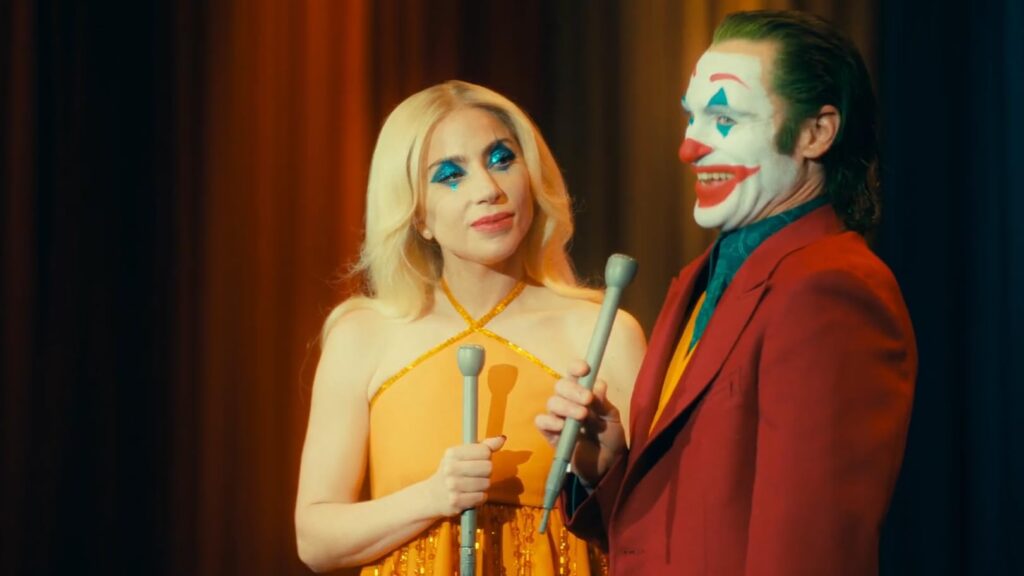
At its core, the film dramatizes the struggle between the masculine and the feminine. Arthur Fleck represents a wounded, alienated masculine force: intelligent yet unmoored, capable of violence yet longing for recognition. Harley Quinn (Lee in the film) embodies a chaotic, receptive, and wounded feminine energy, drawn into Arthur’s orbit through admiration, fantasy, and shared trauma.
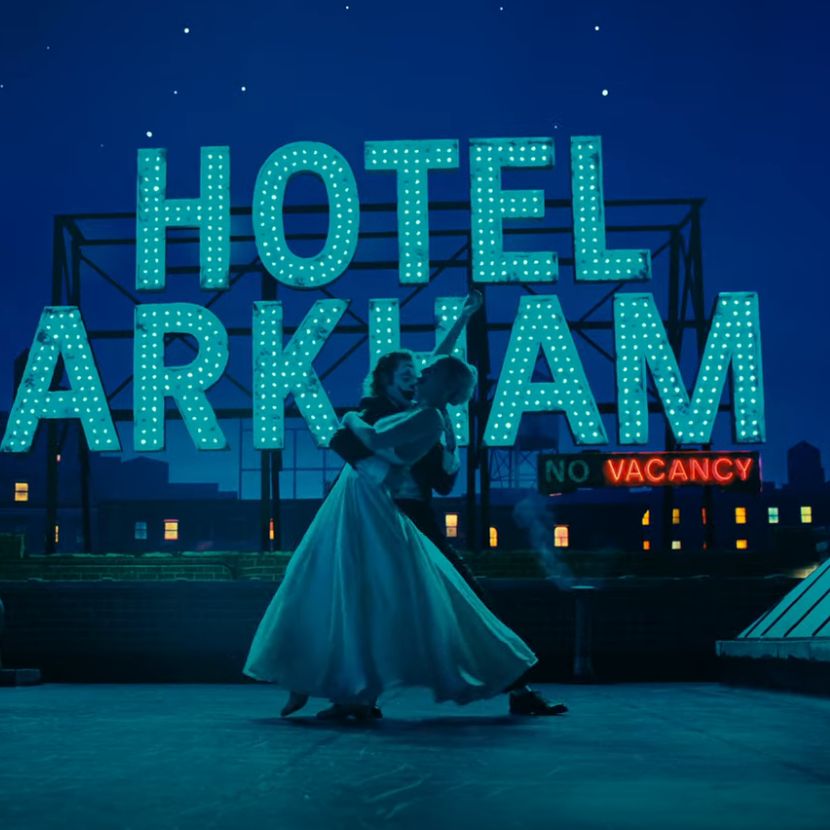
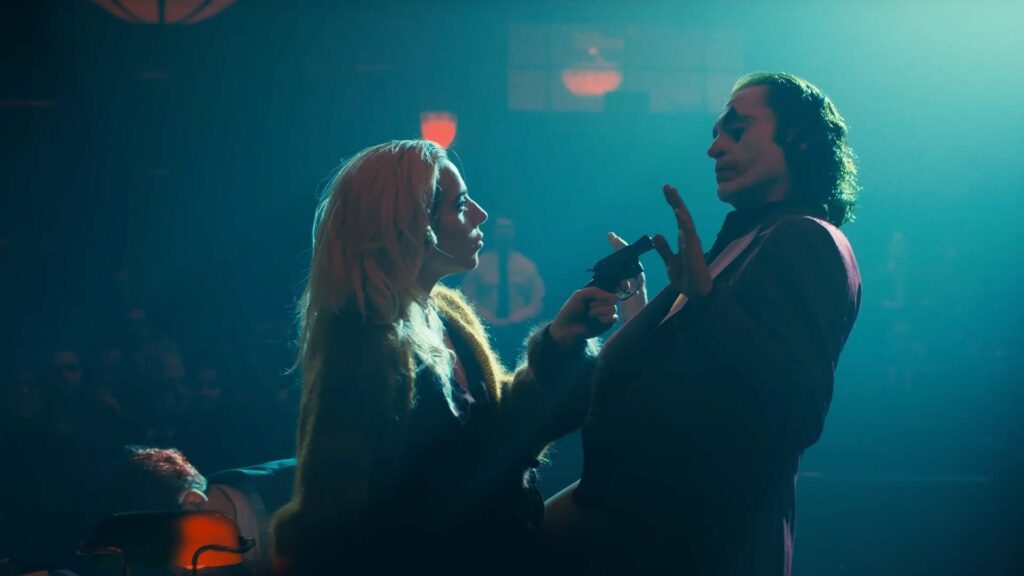
Together, their union is intoxicating, seductive, and theatrical — and yet fundamentally flawed. Their bond is built not on mutual healing or understanding, but on projection, performance, and shared delusion. In the musical sequences, particularly the rooftop tango set to Folie à Deux itself, we see the seductive pull of fantasy: they are enraptured, flying above the constraints of reality. The choreography, costumes, and surreal staging of these numbers visually echo the intoxicating allure of illusory union.
But as the narrative progresses, the cracks become unavoidable. Lee’s fabrications about her past, her claim of pregnancy, and the eventual rejection of Arthur when he renounces the Joker persona reveal a painful truth: they were in love with each other’s image, not the full reality of each other’s selves. The songs that once celebrated union — To Love Somebody, Gonna Build a Mountain — are abruptly undercut by violence, betrayal, or the mundane impossibility of sustaining fantasy.
This dynamic is profoundly prophetic. It mirrors a society increasingly obsessed with spectacle over substance, performance over authenticity, and myth over truth. The Joker–Harley union, seductive yet destructive, becomes a metaphor for cultural trends: when masculine and feminine energies fail to meet in honesty, society is left with performance masquerading as connection.
The Musical as a Medium of Prophecy
The musical form of Folie à Deux amplifies the film’s prophetic resonance. Music, in classical mythology and psychological theory, expresses what words cannot: the raw truth of the human psyche. In Arthur and Harley’s duets, the lyrics are often both beautiful and dissonant, revealing the fragility of their bond even as it dazzles.
The film’s most controversial feature was its use of the musical form. In 2024, this was interpreted as either gimmick or bad thinking. Yet the integration of song and delusion is the film’s central insight. Musical performance, historically associated with collective joy and catharsis, is here repurposed as a symptom of psychosis. Arthur Fleck and Harley Quinn transform their inner fantasies into shared spectacle, blurring the line between reality and performance.
This gets them lost in the dream – the La La Land – and it manifests in the social order by being broadcasted all over the news and TV. This structure reflects a broader social condition: the tendency of late-modern society to aestheticize its crises, to mask despair with distraction. The film anticipates what has since become a defining cultural condition — the simultaneous collapse of truth and proliferation of spectacle. All across the media and news.
For instance, the song performed in the movie called Bewitched transforms into a confession of obsession; When You’re Smiling twists joy into irony; If You Go Away becomes a lament of rupture. Through these songs, the film articulates the paradox of their relationship: the desire for union coexists with the inevitability of delusion and destruction. Society, like these characters, performs its fantasies, mistaking them for reality. The musical sequences, both real and imagined, blur the boundary between appearance and truth, emphasizing the prophetic message: a culture that thrives on performance risks losing the ability to distinguish illusion from reality.
The Bride from Revelation: The Spiritual Overlay
Where Joker (2019) showed the birth of a lone anti-messiah figure, Folie à Deux revealed the next step: the search for a Bride. Arthur finds Harley, and in their delusion she becomes his mirror, his partner, his Bride.
This resonates with the Book of Revelation’s image of the Bride, representing humanity’s readiness to meet the divine. Yet, the Joker and Harley’s union is a twisted parody of that holy marriage: a prophetic warning of what happens when love becomes codependence, when society seeks salvation not in God or truth, but in spectacle and madness.
In Revelation 21:2-9, the Bride symbolizes the ultimate union between the divine and humanity — pure, faithful, and luminous. She is the archetype of perfected feminine energy, the union of love and truth, grace and destiny. In contrast, the Joker–Harley dynamic represents a false union, a shadow of the Bride. In Folie à Deux, Harley is Arthur’s Bride — but twisted. Their marriage is delusion, not salvation. Their union is spectacle, not truth. Their love is intoxicating yet grounded in lies. Their connection is performative rather than spiritual. And their chaos mirrors the fallibility of a society that has strayed from authentic relational and moral foundations.
By juxtaposing this cinematic union with the spiritual archetype of the Bride, the film can be read as a warning: humanity is enacting the shadow version of the sacred union, indulging in fantasies that mimic connection but ultimately fail to fulfill it. Where the Bride of Revelation embodies clarity, truth, and eternal purpose, the Joker and Harley embody the collapse of those virtues in the temporal, chaotic world. Their “marriage” is a parody of divine union: a spectacle that seduces and entertains, but ultimately leaves devastation in its wake.
The film’s shocking finale, once mocked as over-the-top, now feels almost terrifying in its accuracy: a parody of divine union that warns us what happens when we mistake spectacle for salvation. Harley rejects Arthur. Arthur dies. Yet, the Joker persona survives — and society repeats the same mistakes.
Prophetic Implications for Society
Folie à Deux resonates beyond the film itself. Its critique is not just personal; it is societal. The pattern of fantasy → union → betrayal → fallout mirrors trends in contemporary culture:
- Identity and Persona over Reality: Arthur becomes increasingly enthralled with the Joker persona, while Harley’s identity is constructed around his image. In society, we similarly idolize curated personas, myths, and illusions.
- Delusion as Connection: The most intense bonds — whether romantic, cultural, or political — can be built on projection and shared delusion rather than authentic understanding.
- The Persistence of Myth: Even as Arthur dies, the Joker persona survives. Ideas outlive individuals. Similarly, societal illusions continue to shape culture even after the people who created them are gone.
Sound familiar? Society today is addicted to spectacle. Social media is a stage; identity is performance; intimacy is curated, filtered, imagined. Arthur and Harley’s love is the logical conclusion of a world that confuses image for reality.
The film’s musical numbers, its hallucinatory sequences, and its tragic arc collectively form a cautionary tale: when humans pursue union without grounding it in truth and mutual recognition, chaos and despair follow.
Rewatching Folie à Deux now, its images hit with uncanny accuracy:
- The Asylum Chorus: Inmates breaking into song mirror the way society descends into collective delusion — millions trapped in echo chambers, chanting in unison online.
- Arthur and Harley’s Romance: Their “folie” (shared madness) is a distorted mirror of humanity’s struggle for union: man and woman, self and other, craving love but collapsing into codependence.
- The Music of Denial: The musical structure itself becomes the prophecy — the soundtrack of a culture trying to dance away despair.
Looking back, Folie à Deux predicted the emotional atmosphere of the mid 2020s. Through its surreal musical interludes, it captured the dissonance between the world’s collapse into chaos and our culture’s desperate attempt to sing its way through.
It wasn’t just a romance. It was Revelation.
Why It Was Too Early
Had Folie à Deux released a few years later, audiences might have been ready. By then, the fractures in society, the spread of collective madness, and the hunger for authentic union would be undeniable. But in 2024, it felt alien.
The film’s premature rejection echoes the fate of many prophetic texts, which are initially dismissed precisely because they strike too close to truths not yet ready to be acknowledged. Like many prophetic works, it arrived before its time.
In hindsight, Joker: Folie à Deux can be recognized as a prophetic classic — a film that anticipated the psychic condition of its age with disturbing accuracy. Its fusion of madness and musical form, its parody of the Bride motif, and its allegorical depiction of collective delusion position it as one of the most theologically and culturally resonant films of its era, destined to be appreciated as a warning and mythic mirror for generations to come.
Folie à Deux asks: what happens when masculine and feminine energies collide without truth? When we idolize images instead of people? When love is fantasy and spectacle?
The answer is: chaos. Violence. Alienation. Broken relationships. A society performing for applause, not living in authenticity.
And yet, like all prophecies, most people will watch this film and miss the warning. They will leave talking about the songs, the spectacle, the romance — but the real message will echo unheard, like a ghost: we are creating our own Joker–Harley world, and it won’t end well.
The Message for Today
Joker: Folie à Deux is no longer just a strange sequel. It’s a mirror. It shows us the danger of living in delusion, of turning love into codependence, of mistaking spectacle for truth.
Arthur is the fallen self, desperate for recognition. Harley is the Bride, humanity’s longing for union — but twisted by ego and madness. Their romance warns us: without humility, without truth, our longing for salvation will turn destructive.
Joker: Folie à Deux is more than a dark romance or musical spectacle; it is a modern parable of shared delusion, fractured union, and societal decay. The sacred archetype of authentic union stands as a counterpoint to their chaos, reminding us of what is possible — and of the cost when humanity strays from it.
Folie à Deux is a call — hidden in grotesque laughter and song — for humanity to awaken, to choose truth over delusion, love over spectacle, God over Joker. Ignore it, and you too might be dancing in a duet of delusion, with society as your stage, spectacle as your anthem, and chaos as your inheritance.
When the first Joker movie was a predictable blockbuster, the second one was considered an auteur-driven flop. Yet, having earned millions from the movie, Todd Phillips and Joaquin Phoenix managed to fool the Hollywood system, push their message of prophecy out there, and will have the last laugh. That’s Joker Two. And that’s pretty genius.
We weren’t ready then. But now we are. And its message couldn’t be clearer: we must awaken — or we will dance ourselves into oblivion.