
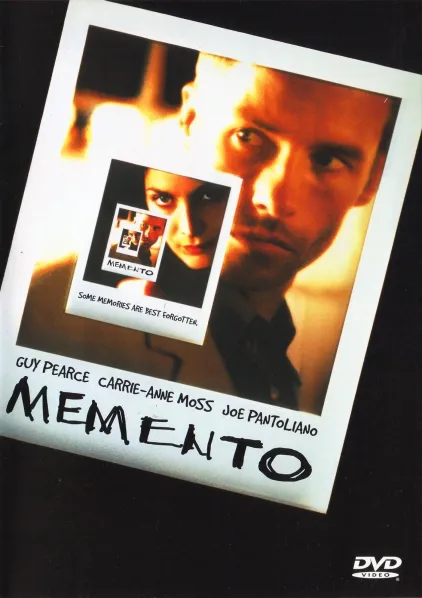
Christopher Nolan’s Memento isn’t just a great film—it’s a structural revelation about how human consciousness encounters truth. And remarkably, it’s structured very much like Christianity.
Every Christian’s journey begins the same way Leonard Shelby’s begins: with an ending that is actually a beginning.
This analysis interprets the film not only psychologically, but spiritually.
To begin, what is the central message of Christianity?
Well, we don’t usually start with Genesis. We start with the death.
You don’t hear about Adam first. You hear about Jesus. Someone tells you the good news—God became man, died and rose again, and this changes everything. The sacrifice, the death, the resurrection: this is your entry point. This is where Christianity’s spiritual meaning detonates into your life. Everything moves backward from that rupture.
Memento begins similarly. There’s a brutal murder scene. Very Biblical. But there’s no Jesus, but the antihero. It’s the inverted version. A revenge story. A neo-noir film. Humanity has fallen. But what it shares with Christianity is the chronological order you experience the story, the journey your consciousness embarks on.
This is also a good opening for a film. When you first hear the gospel, you hear about Jesus. Not as the conclusion of a long story you’ve been following, but as the explosive revelation that makes you want to know the story at all.
Memento works the same way. We see the ending—Leonard has gotten his revenge. The atonement has been reached. The world isn’t saved with love. But retribution is achieved with violence.
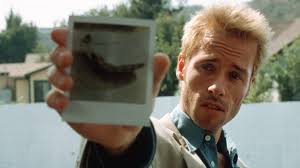
You’re pulled in. Who was this person? You explore backward—like a Christian studying the Bible, reading Gospels, epistles, prophecies, law, history, poetry, creation. Each text is a polaroid, a note, a tattoo. Each piece of evidence changes what the other pieces mean. The more you read backward, the more everything converges, the closer you get to the foundation, the more you understand why it all led to the cross where you started.
Linear storytelling—beginning, middle, end—is clear and comfortable. But it doesn’t reflect how we actually encounter truth.
In Memento, the murder of Leonard’s wife is the event that shatters chronology. Everything moves from that rupture, trying to reconstruct what happened after memory failed.
In biblical narrative, the fall is the equivalent arc. We are descending from being present with God in Eden to getting spiritually further and further away. Until the past is forgotten completely.
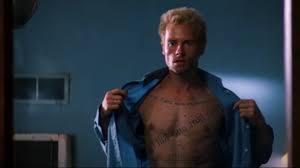
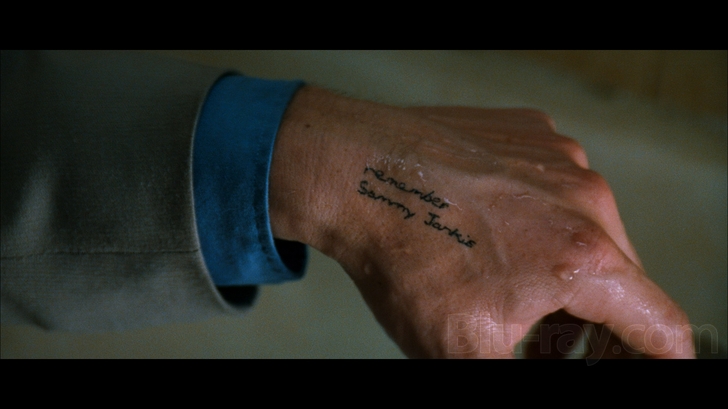
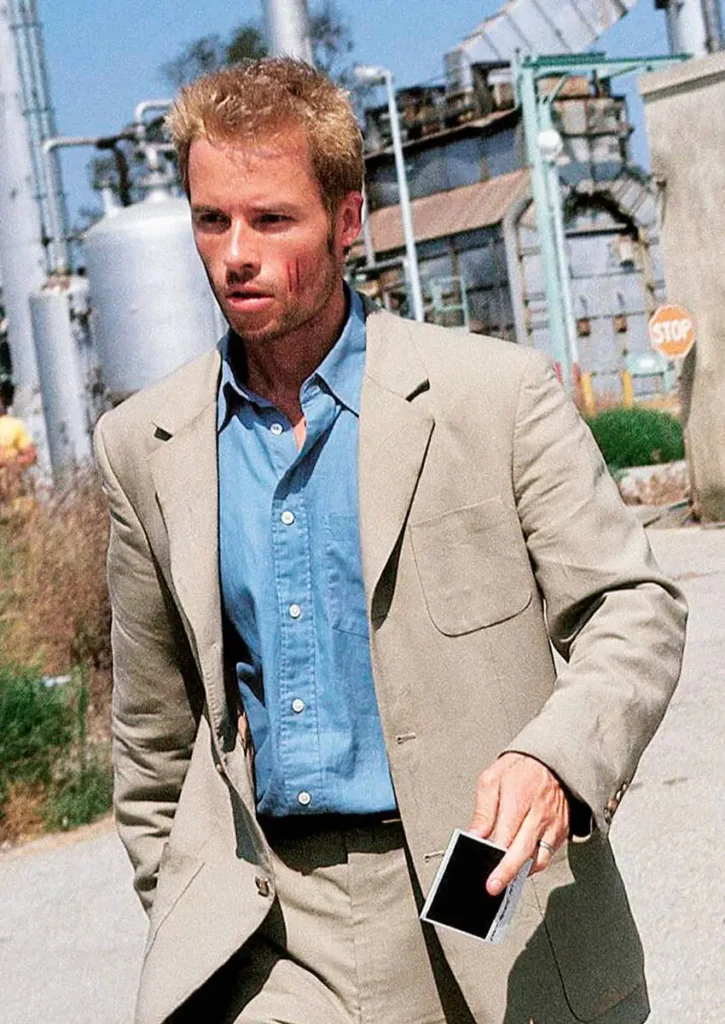
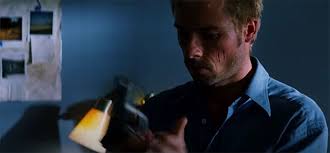
Likewise, Leonard wakes up in a motel room with tattoos he doesn’t remember getting, holding polaroids of people he doesn’t recognize, reading notes he wrote to himself that make no sense. His entire quest begins from the catastrophic ending—his wife is dead, he has a condition, he’s hunting someone. But he has to work backward to understand: Who am I? What happened? Why am I here? What do these clues mean?
This “investigation”, the detective work for his wife’s murderer, is one half of Memento’s narrative puzzle.
Leonard continues through time—new motel rooms, new encounters, new evidence. But what we are seeing is always working backward, trying to reconstruct what happened before, trying to understand the origin that explains his present condition.
The structure of Memento reflects this: the color sequences move backward through time, while the black-and-white sequences move forward, and they converge at a single moment—the revelation where beginning meets ending and revelation emerges.
Christianity works identically. This is no hyperbole.
The polaroids, the tattoos, the notes—these are Leonard’s scripture. Evidence he’s collected, arranged, studied, trying to work backward from his present condition to understand the origin.
This is how consciousness itself evolves. As a story structured like Memento.
Moving Forward While Reading Backward
This is the genius of both Memento and Christian experience: you’re living forward while understanding backward.
Leonard’s journey backward isn’t random searching—it’s moving toward a revelation. He believes if he can get back to the origin, back to the moment his wife died, back to the source of his condition, he’ll find the truth that makes everything make sense.
The Christian does exactly this. You move forward through your life—work, relationships, decisions, experiences. But spiritually, you’re reading backward. You start with Jesus and work your way back. You read the Gospels and discover they point back to prophets. You read the prophets and discover they point back to Moses. You read Moses and discover it points back to Abraham. You read Abraham and discover it points back to Adam. You read Adam and discover it points back to creation itself. Each step backward illuminates more of the story, brings you closer to the foundation, helps explain why everything led to the cross where you began.
Christianity has the same structure. “In the beginning was the Word, and the Word was with God, and the Word was God” (John 1:1). You start with Jesus dead on a cross, and you read backward through history—through Israel, through Moses, through the patriarchs, through Eden, through creation—until you discover that Jesus was there at the very beginning.
Luke’s Gospel pushes the backward reading to its logical extreme: Describing the genealogy of Jesus, Luke starts from Jesus, moving backwards to Joseph, all the way back to Adam and God. The ending you started with was the beginning all along. The Word became flesh, but the Word already existed before anything was made.
Jesus doesn’t emerge from the scriptures—he interprets the scriptures to be about himself. This is reading backward. The ending (resurrection) determines what the beginning (Moses) meant. The ending creates the meaning of the beginning.
How Consciousness Actually Works
What makes Memento profound—and what makes Christianity’s structure profound—is that this is actually how consciousness operates and evolves.
We don’t understand our lives by accumulating experiences forward. We understand our lives by reading backward from who we’ve become.
This is Leonard’s condition made universal. We’re all working with incomplete information, fragmented memories, partial understanding. We’re all reading polaroids and tattoos, trying to work backward from our present to understand the past. And new revelations constantly change what everything prior meant.
Leonard leaves himself notes because he knows he’ll forget. “Don’t trust her.” “He’s lying.” “Remember Sammy Jankis.” These notes are external memory, physical evidence to compensate for consciousness that can’t maintain continuity.
The Bible works the same way for the Christian community. It’s the notes we’ve left ourselves, the polaroids we’ve photographed, the evidence we’ve tattooed into text so we don’t forget.
“Remember that you were slaves in Egypt.” “Remember the Sabbath day.” “Do this in remembrance of me.”
Why the repetition? Because memory fails. Because consciousness can’t maintain the story forward without external markers. Because if we don’t write it down, photograph it, inscribe it permanently, we’ll wake up tomorrow having forgotten who we are.
And like Leonard reading his own notes, we read Scripture not to learn new information but to remember what we’ve already discovered—to reconstruct the backward path from the revelation (Jesus) to the foundation (creation) that makes sense of our present condition.
Memento isn’t just telling a story—it’s creating an experience of how narration actually works in consciousness.

You don’t watch Memento and passively receive information. You actively participate in reconstruction. You’re given fragments—scenes out of order, incomplete information, unreliable evidence—and you have to work backward and forward simultaneously, assembling meaning, discovering connections, experiencing revelation as the pieces converge.
This is exactly what engaging with Christianity feels like. You’re not passively reading a history book that moves from page one to the end. You’re actively participating in backward reconstruction.
And like Memento, the experience is non-linear but coherent. You’re moving forward in your understanding while exploring backward in history. You’re living chronologically while reading reverse-chronologically. You’re experiencing time linearly while meaning moves backward.
You don’t understand God by starting with Genesis and reading forward. Genesis doesn’t make sense until you’ve read backward from Jesus. Creation isn’t the beginning—it’s what you discover when you read backward far enough. The Word was already there. Jesus explains Genesis, not the other way around.
You begin with the cross. The cosmic event. The death that shouldn’t have been death. The ending that turned out to be a beginning. And from that moment, everything moves backward and forwards.
In Christianity, this single event—occurring roughly 30 CE—sends shockwaves both forward and backward through time:
Backward:
- Recontextualizes every prior event
- Transforms history into prophecy
- Makes the entire Old Testament “point to” something it didn’t mention
Forward:
- Creates the church
- Generates new scriptures (Gospels, epistles)
- Redefines covenant, law, tribe, salvation
The resurrection doesn’t emerge from Jewish scripture—it explodes into Jewish scripture from outside, forcing every text to reorganize around this new gravitational center.
This is not a bug. It’s the architecture of revelation itself.
We go forward. And backward.
Consciousness advances in loops. Living and understanding more. Then seeing the revelation in the beginning.
Then a new cycle begins. Repeatedly. Again and again.
The Answer to Everything
Leonard’s quest is for the answer to everything: Who killed my wife? Why am I like this? What happened? The backward investigation is meant to converge on a revelation that explains all of it.
The Christian’s quest is the same: Why is the world like this? Why is there suffering? What is the meaning of existence? What happened? The backward reading through Scripture is meant to converge on a revelation that explains all of it.
And remarkably, both arrive at the same structural answer: The ending was the beginning.
The meaning was to understand the beginning.
The film is structured like faith itself. You start with the death. You work backward to the beginning. You move forward while exploring the past.
Likewise, we search for the foundation where everything started. Consciousness operates moving both directions the future and past simultaneously until it converges on truth.
But standing in 2026, reading backward, a revelation occurs. The scientific method gave us technological power before wisdom. Democracy gave us mass manipulation masquerading as liberation. The information age gave us knowledge without understanding. Abundance gave us consumption without meaning.
Humanity has been reading history forward: from superstition to science, from tyranny to democracy, from ignorance to knowledge, from scarcity to abundance. The narrative was progressive—each generation building on the last, gradually approaching truth, slowly perfecting human society.
The Enlightenment project didn’t fail—it succeeded completely, and its success revealed that reason without restraint, liberation without limits produces not utopia but a spiritual dystopia. We achieved everything the Enlightenment promised and discovered that achievement wasn’t salvation.
It brought chaos like the character of Joker said in The Dark Knight.
Now, like Leonard manipulating his own memory system, we’re actively choosing which evidence to preserve and which to destroy. Cancel culture, content moderation, deplatforming, fact-checking—these aren’t neutral curation but narrative construction. Each choice about what persists and what disappears is a choice about what the past will mean.
Memento is great because it doesn’t just tell you a story—it makes you experience how consciousness actually encounters truth.
It’s great because it mirrors something profound about how meaning actually works in human experience: not through accumulation but through revelation that reorders everything retroactively.
And it’s great because whether Nolan knew it or not, he built his film on the same architecture that Christianity has always used: You begin with the sacrifice, you hear the good news, and then you read backward to discover what it all meant, how it all makes sense, why everything led to this moment.
It’s a great story because it’s not just a great story—it’s the structure of the great story, the pattern of how we encounter revelation, the architecture of consciousness moving toward truth.
We go back to the beginning. Back in time to the source. Back to the Word. And we discover it was all there from the start—we just had to begin at the ending to see it.
So what is it we have forgotten? What is our past?
We cannot move forward until we first acknowledge together as human species what is our shared genesis and meaning and where are we meant to move towards.
Leonard, in the film’s final moments, makes a choice. He knows he’s manipulating himself. He knows his quest for truth is really a construction of convenient fiction. But he chooses to continue the manipulation, chooses the comforting narrative over the devastating truth.
Question is,
Will we do the same?